There go the credit union assets

I usually try to be around the front door when the credit union closes. Though I am of no use in balancing the MSR’s there are usually some other tasks that need to be taken care of. And everyone gets to chat a bit about how the day went, who the good members were, what unique events happened and generally just try to wind down a bit before heading home.

As the staff leave I am reminded of what someone told me about their company at a similar time. He said he usually looks out at the parking lot as the staff leaves and thinks “There goes the company’s assets”. And he is right. The thought crosses my mind more often than nought that as the staff leave so goes the credit union assets. We wouldn’t be close to being the credit union we are without those people. They are the living and breathing assets that give the face to this institution. And without them we would not exist. By the way Mt. Lehman Credit Union’s 65th birthday was on Monday August 6th. Funny none of that staff looked at all like 65!

It has got to be summer time

This past week has been hectic – work, home, weddings, football game, re-setting alarms in the early morning and typical holiday traffic on the freeway. So not much in the way of writing or reading. This morning I was working on my site at MediaTemple and inadvertantly deleted a WordPress setup. Whoops! That lead to a bit of exploring and I finally made some headway understanding how some of these features work. Now I am thinking about moving some things around but it will take time. MediaTemple has to be one of the best hosting companies I have seen since Wimsey. Anyway it’s BC Day today and time to get outside.

What seems to be happening with our knowledge

The book Everything is Miscellaneous by David Weinberger is terribly intriguing. He states that our knowledge of the world has assumed the shape of a tree because that knowledge has been shackled to the physical. He repeats this notion numerous times in cataloguing information onto atoms. [putting the catalogue on index cards] With information being digitized, which allows us to go beyond the physical means, the shape of our knowledge is changing. Note he doesn’t say our knowledge is changing, just the shape of it.

There seems to be a pre-occupation with the notion of singleness [each-only-one-what] when dealing with knowledge in tree shapes. He gives us the following embedded assumptions that are so deep in our tradition of thought that they look like common sense.

  1. A well-constructed tree gives each thing a place. If too many items haven’t a place our miscellaenous category begins.
  2. Each thing gets only one place. Listing something more than once is confusing. Where should it go?
  3. No one category should be too big or small. This really points to an inadequacy in the method, not the knowledge.
  4. It should be obvious what the defning principle of each category is. Exactness, precision.

So where does that leave us? We are still trying to bridge the old model of viewing information with the attempt of trying new ways. We continue to grasp our “belief in the efficiency of rationality“. When one uses the word belief in these terms it becomes dogma and whoa to those who don’t follow that dogma. Dogmas with data are dangerous.

Some new ways – wikis, metadata, tags, facetted classification systems. We need to begin to use these new tools in our look for answers when faced with the magnitude of information we see daily. It’s hard to grasp sometimes and move away from paper and atoms. Paper has its place but when you can choose to store, sort and read it digitally vs the older way which really is the easiest?

Miscellaneous Infant Toys 3302.jpg (JPEG Image, 640x480 pixels)

The question Wesabe is asking

Wesabe has an unbelievable product available to anyone who has the facility get get at their transaction data. They have delivered what some of us have thought about for awhile now, financial data and tagging. And they have brought how to use tagging to the easiest method imaginable. Then you have their graphing function, the ability to ‘vote’ on how you think the supplier is, Firefox uploader, browser snapshots, the list goes on. Did I mentioned the social networking aspect of giving financial tips?

So the question is, as a credit union, do you build something like this, which will take time and money and probably be a poor imitation. Or do you say to your members “This is the greatest thing since sliced bread. Here is what we can do to get you going on a truly innovative and valuable service!” But wait, some will say, and so begins the “if we don’t build it others will and we will loose out” discussion starts or “we must build it or it will dilute our brand” discussion continues.

What really should happen is that the member’s data, their financial transactions, should be viewed as their’s, not the banks or credit union’s. They spent the money, and paid for the service, they have every right to do with it as they see fit. And if Wesabe’s service is what they want then we should respond by doing what we can to make it easy for them to do it. And we should work with Wesabe to see how collectively we can serve our members better.

Will this model work? Yes I think it will because a good idea is a good idea is a good idea and you can’t keep something like this off people’s radar screen. Is it a revenue generator? No but does everything we do have to be. It builds a relationship. It assists people in getting a handle on how they spend money. It helps them to save money. It does everything that we have been trying to do, promote common sense and money usage.

As I have said before, banks and credit unions have become something like huge castles with moats around them and the drawbridge up. Then the Wesabians come marching up asking for what is theirs to do what they wish to do with it. We can lower that drawbridge and stop this financial feudilsm that is wasting time and resources for everyone. We need to listen that some have chosen a new financial polity.


Stuff one thinks about driving to work in the morning

  • TV – This weekend while in Seattle I had the TV set on. We don’t have TV at home so I thought it would be great to see what’s on. Guess what? Nothing, nothing, nothing. More chanels of nothing. And the advertising, it has gotten worse. To top it all off CBC had the movie Troy on with commercials every 5 minutes. Sorry but the library looks even better now.
  • On leadership – “Don’t be afraid to lead, the challenges will come in any event”.
  • BarCampBankSeattle – lots of young, dynamic leaders.
  • New t-shirts – “Blog with Passion”
  • Brands need to be based on pillars and these pillars need to be placed on the ground of principles.
  • Ning.com – is this going to take off at some point?
  • Every system must enable the user.

BarCampBankSeattle (BCBS) and the need for tattoos

Near the end of the Saturday session (someone correct me if I am wrong) we got into a great debate because of Jesse’s two teller conundrum. I mentioned that every GM should have the 7 Co-operative Principles tattooed to their butts. From that point it moved into some laughable circles. But the interesting point was that most did not know about these principles. Maybe they did, or had read them, but they weren’t at the top of my mind and I couldn’t repeat them verbatim. One quick point – on the link above there is a bold comment at the end “We embrace and live by these principles”. Wow, those are tattooing words!

Today I was looking at Denis Wymore’s home page and what is there — a note about her book “Tattoos: the Ultimate Proof of a Successful Brand”. This is now getting to look very different. Successful brands have tattoos but we who consider ourselves credit unionists can’t repeat a single cooperative principle. What does that say about our brand? We talked about creating a manifesto from the weekend’s meeting. Each of these principles could be wordsmithed into an understandable, concise language that would fit what we talked about. So here is one feeble attempt at it.
Open Membership – open to everyone willing to accept the responsibilities of membership. Since when did any of us hear of a “responsibility of membership”? What is it? Maybe we have been thinking to much of “me” and not enough of “we” when decided responsibilities.

– one member, one vote. Interesting. No proxies. Someone once told me there are 4 ways to make a decision

  1. Consensus, the best way but very time consuming and we never have time for something like this right?
  2. Compromise, the politician’s way when you get something, I get something and the guy at the end of the line gets nothing.
  3. Vote, yes our democratic principle that means those that have the biggest teams, armies or mobs get to decide usually with the big group controlling the agenda and deciding who gets #4.
  4. Crucifixion – I will leave it at that.

So which even if we do vote to make decision why does everyone feel like someone got dealt #4?

Democratic member control – members who actively participate in setting their policies and making decisions. Now there is a time bomb. Since when did any CEO and the senior VP team listen and act in direct concert with members in “setting their policies and making decisions”. We have listened to regulators, consultants, economists, politicians, bureaucrats, bankers (of course) and everyone who is NOT a member it seems, in setting policies and making decisions. Notice it says their policies. Policies of the individual and autonomous and system minded credit union.

In the next post I will pick up on a few more of these tattooable items.


Take the survey while sitting in a chair

One of the more frequent comments we hear from people who come to Mt. Lehman Credit Union is that “it really feels different here”. So you ask them how they came to that conclusion. They mention that while they were waiting they took a seat and noticed what was happening in the branch as the staff were working and the members were conducting business. They noticed how people were being served, how the conversations at the counter were taking place, how there was so much natural sunlight, and how it just felt good and friendly. This is the stuff credit unions are made of. Now how would you measure this? Again the question of how do you measure the quality of a business.

It got me thinking. How many businesses have chairs that you can park your butt down and just notice what is happening? Sure FI’s have seatting because there are always appointments. Our seats are also used if people want to sit while waiting for a teller. There is a device that alerts staff after anyone sits in the chair for longer than 47 seconds (just kidding). For some businesses it would be difficult to do this. There should be a law that any women’s shop have seatting available for husbands who will be there for awhile. But really if you as an individual were to measure if you wanted to do business with anyone, why not just be a silent sitter for 10 minutes and see what is going on. See if there truly is a unique experience there. How you view the experience is the active survey.

skoolchair.jpg

Not a good but a great Open Space Event in Seattle

The Open Space event in Seattle (BarCampBankSeattle) ended today. You will be reading posts now and in the following days that will attempt to bring to words the unique experiences we all shared. And it was unanimous – the event exceeded expectations.
Why was it so good? As William has pointed out, all of us have been writing about the financial industry, sharing thoughts, comments and dialogue about how we felt concerning all aspects of the banking business. This really set the stage. We were ready and willing to move this social media to the next plateau – face to face discussions. The Open Source method of meeting was the perfect type of venue to do this. Everyone contributed to the debates from the start with no need for much of personal introductions. There were no name tags, as in most instances we already “knew” the person. The passion and energy was as much as part of the experience as anything else.
The PBWiki has all the notes so take a look there to see what was discussed. Most agreed it was one of the best meetings that any of us has attended. It could not have been planned better. It was the ‘Wisdom of Crowds’ in action. It was the start for some to put old dreams into action. It was just flippin’ great.

The evening before the BarCampBankSeattle

Finally arrived here after a 6 hour journey [Vancouver-Seattle]. The border wait was 2 hours, the I-5 was backed up to Everett so there was the other 4 hours. One begins to feel claustrophobic being surrounded by that many cars for that long.

Got into the hotel room and got a call from Brad Garland & Mark McSpadden from The Garland Group to go for supper at Elliot’s. Great guys. We had some interesting discussions about banking, Web 2.0, and Ruby on Rails. If this is any indication of what is in store for the next 2 days there is going to be some significant discussions around banking and technology. Great minds think alike…

BarCampBankSeattle is happening

Next week the BarCampBankSeattle is happening. Jesse Robins has put this together and there are going to be some very interesting discussions given the attendee list. It is the first BarCampBank event to be held in the United States. O’Reilly Radar, Trabian, Wesabe, Currency and the list goes on. There will be a good mix of operators and pundits, all associated with financial institutions.
One of the questions that keeps me awake at times is how will banking be able to augment their positions and strategies with the use of Web 2.0 energies and the Social Media wave? Banking has been rigid in so much of what it has done in the past. There is always the cover of privacy and secrecy when discussing financial matters with people. Will FIs create and be able to use these new key imperatives? Wesabe is the closest service that fulfills these elements. There is always the view of how the product will be balanced (social vs privacy/security) and how will the member/customer take to it.
Seattle may be the start of some new and innovative ways of how to bank. And that is long overdue.

The Assh**le book that hits the nail on the head.

I am reading a book titled “The No Asshole Rule” by Robert I. Sutton. (I apologize for anyone that is offended at this particular juncture due to the title but I think most have heard the word before). The book is subtitled – Building a Civilized Workplace and Surviving One That Isn’t.
Most of us have had to deal with these kinds of people over the years. At some point our radar suddenly comes on and we realize that this co-worker, boss, supervisor is an assh**le. The radar is working but what exactly is going on here.
Sutton produces two tests for spotting a person acting like an assh**le.
Test One. After talking to the alleged assh**le, does the “target” feel oppressed, humiliated, de-energized, or belittled by the person? In particular, does the target feel worse about themselves?
Test Two. Does the alleged assh**le aim his or her venom at people who are less powerful rather than at those people who are more powerful?
The tests work. But then he goes on to produce THE DIRTY DOZEN – Common everyday actions that assh**les use.

  1. Personal insults
  2. Invading one’s personal territory”
  3. Uninvited personal contact
  4. Threats and intimidation, both verbal and nonverbal.
  5. “Sarcastic jokes” & “teasing” used as insult delivery systems
  6. Withering e-mail flames
  7. Status slaps intended to humiliate victims
  8. Public shaming or “status degradation” rituals
  9. Rude interruptions
  10. Two-faced attacks
  11. Dirty looks
  12. Treating people as if they are invisible

He goes on to say that we all suffer from these traits at times but the typical assh**le lives day to day with these traits. They are consistent.
The book is only 186 pages. His blog expands on the book. Required reading for anyone in an office with more than 2 people.

One very interesting book

Today there isn’t a paper, magazine or news broadcast that we hear or read that does not state something about the Middle East and the conflict that is occurring. I questioned numerous times what was really going on over there. Most, if not all of my perception, was governed by these sources. When living in Denmark I attended a language school for 9 months and made friends with a number of individuals from the Middle East. Kurds, Iraqis, Iranians, they were all interesting people that had some unbelievable stories. I came to know them very well and was always taken aback by their honesty and hospitality. This personal contact confused my understanding of the situation. I wondered how could this area be in such turmoil after knowing such wonderful people?

After reading The Shia Revival by Vali Nasr much of what I understood about the people and this area has taken on a new light. This book is exceptionally well written and goes to explain in depth the Shiism and Shia-Sunni conflicts. This book provides the understanding of the political and theological struggles within Islam. You will not view the Middle East in your pre-defined terms again.

Why small credit unions have some unique advantages today

Tim has forced me to respond to his comment on Cuesskybox’s entry for Small Credit Unions. So maybe there are 10 good reasons on why ‘Small is Beautiful’ for credit unions.

  1. Relationships – smallness dictates that the number of relationships between members, staff and board is manageable for all parties. There is a quality, not quantity, in relationships.
  2. Communication is quick and inclusive.
  3. Transparency. There is always an understanding on why things are happening.
  4. Challenges that are healthy. Being small means you can’t take anything for granted.
  5. Agility in being able to move and respond quickly to any circumstance.
  6. Planning that is truly dynamic. You have a plan but you are constantly reviewing and upgrading it based on any and all communication received.
  7. Teamwork. Everyone can participate in the continuing sense of accomplishment.
  8. Managing your own destiny. There are market conditions and circumstances beyond anyone’s control but you can steer and manage quickly and precisely. You aren’t a 53 branch credit union so can manage in a much different direction.
  9. Technology is cheap. If you put the pillars you need in place to use technology as a strategic advantage, today’s hardware prices and work tools have never been cheaper or more powerful. You can build what you need.
  10. Politics don’t get in the way of accomplishing what needs to be done.
  11. Members, members, members. The always come first.

I haven’t posted in a week with all the family events recently (niece from Denmark, youngest son moving to Denmark). When the weather is good computer screens look a little gruesome.

Cities on Flickr

Flickr has some amazing information that is not all pictures. When you type in a search you get the number of photos that apply to that tag. So here are some results.

  • London 2,119,240
  • Paris 1,898,223
  • San Francisco 1,798,543
  • “San Francisco” 1,439,052
  • “New York” 2,045,106
  • New York 1,273,920
  • Berlin 887,633
  • Toronto 647,984
  • Vancouver 619,292
  • Victoria 461,933
  • Ottawa 167,469
  • Whistler 112,765
  • Regina 43,844
  • Bellingham 23,202
  • Burnaby 18,103
  • Blaine 13,008
  • Chilliwack 5,361
  • Coquitlam 4,478

Surprising that the ” ” were lower with SF and higher with NY but then New York is also a state. London and Paris no surprise. Berlin was. And the centre of the universe, Toronto, wasn’t that much higher than Toronto (but then maybe Vancouver also included Washington state’s Vancouver). Victoria with that many more pictures than Ottawa? It hurts that Bellingham beats out Burnaby. But at the bottom of the list Blaine beating out Chilliwack and Coquitlam? There goes the neighbourhood!

Mitch Joel from Twist Image presented Social Media Marketing and Web 2.0 today.

It started at 8:00 am and went to a little before 5:00 pm. It was a long day but it only seemed like a few hours. If you have never heard or seen Mitch Joel do yourself a favour and don’t miss him. This person has a passion with a capital ‘P’. He explains, teaches, provokes and doesn’t always agree with the audience but that passion shows every single minute. He is punctual and that again is with a capital ‘P’.
Of course the overhead wasn’t working at the beginning but we all received a bound handout of the 281 page presentation. These were not your typical PowerPoint bullet point ‘Captains of Industry’ presentation pages. And so we started without the tech apparatus and you didn’t feel you were missing anything. This presentation had a lot of punch with liberal use of the net and videos. He punctuated the necessary emphasis with choice language. If there was an easy way to make a point Mitch found it. When you came away you knew you had something to chew on for a long time. You can see the course outline at IAB Canada here.
What made this presentation different than the plethora of tech courses always offered? You always felt he was talking directly to you. Even if what he was presenting was already known, he made it feel ‘new’. We could have spent another day just in discussion about all that was presented. So when does the level two course on Social Media Marketing take place? We will all be back. And like you said Mitch, this is just the beginning.

062020071251.jpg

What is MN2?

mn2.gif

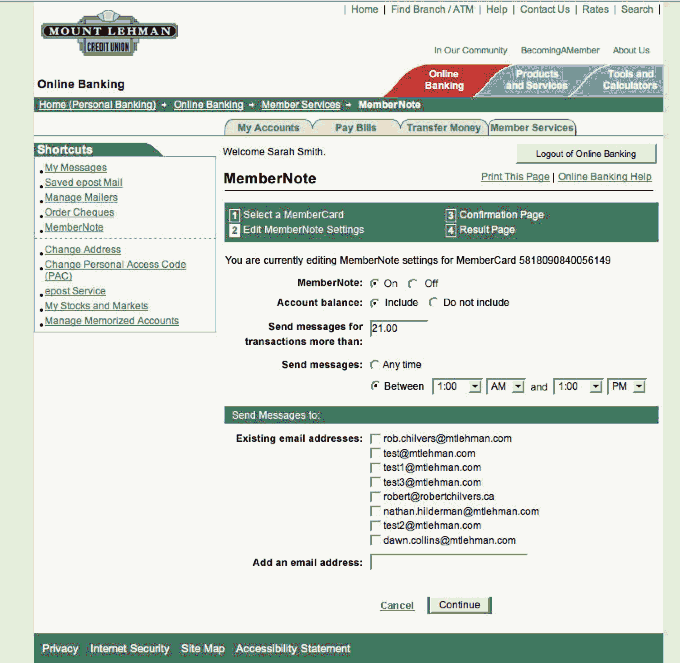
Today is the launch of our new DIY product, MemberNote 2. (We have had MemberNote for over 2 years now). As mentioned before, a long time ago, this is the 2nd version of the text/e-mail alert product that will send a message every-time you use your plastic card (ATM, Interac, & ATM queries – this is one of the major differences with MN2, we can alert you when there has been a request for a balance at an ATM. It is not necessarily transaction driven which seems to be a unique aspect of this product and allows us to develop with greater scope).
The development took much more time than we or CUCBC expected. There were some interesting elements that needed to be created to allow this.
So where do we go from here? We are compiling some interesting information on usage and demographics from the product. We have also found that whatever the explanation the best way for people to understand what it does is to use it. It has a pretty explosive WOW! factor once they see it in operation. The DIY component is a key hinge point for the product now and in the future. But how far will or can we take it? The infrastructure is in place to move it forward in whatever direction is deemed necessary. What we need to do is listen, listen, listen.
I have included a snapshot of the final DIY web interface. Sorry there isn’t a site to show you. You have to be a member and sign in to get that far.
PS Just a few days ago the idea came to the forefront – Can’t we text message people when they use the DIY page? Now whenever you change anything you get the message that it has been changed or if you are a new user there a welcome message. Isn’t small beautiful?

mss.gif

The core of good service – teamwork

One of the most important aspects of the credit union is the environment in which we work. There is no sense in fooling ourselves, without the best people we don’t have much of a hope of being a healthy credit union. All of our own work histories can easily point to jobs where it wasn’t much fun coming to work because the place was full of jerks and jerkesses. A key element in any workplace is teamwork. This is what makes the organization great instead of just good.

We speak of product, price and service with a sense that all three are commodities. Price certainly is the attribute of a commodity, product I will leave for another blog entry and service is what can really set the credit union apart from anyone else.

What makes an organization? The people. And service is the people who put that human envelope and character on your product. They deliver the product in the most vital of fashions, with the human aspect. The delivery of the product, the timing of the delivery of the product, the atmosphere in presentation of the product, the setting and the venue all point to peripherals of service. And teamwork is at its core.

With all great ideas come great execution. The ability to get things done for people in this business is very important. The execution comes when people work together for that common goal, to deliver great service. The ability to work towards that collective goal out of a sake of service and caring is a challenge to the “sales culture” which in fact by it’s nature of competitiveness can erode the “service culture”.

Our motto at work is “Where neighbours bank”. We work hard at making a difference. For example, and forgive me as this is a pet peeve of mine. line-ups. Ask anyone what they hate and it is a line-up. So why do we credit unions who pride ourselves as being member focused and service orientated allow habitual line-ups? I think it because we don’t have the teamwork in place to get rid of the line-up. We need to focus on the member and by making sure the line-ups are minimal or non-existent this gives adequate proof that we are. That is the ingredient that seems to be missing. People working together can accomplish much and there is a beauty in not being afraid to try something different. That difference in what you do will define who you are. That difference is teamwork and the delivery of great service. No job is too small or too unimportant for anyone in any organization to do. People notice that and isn’t that what the delivery of service is all about?

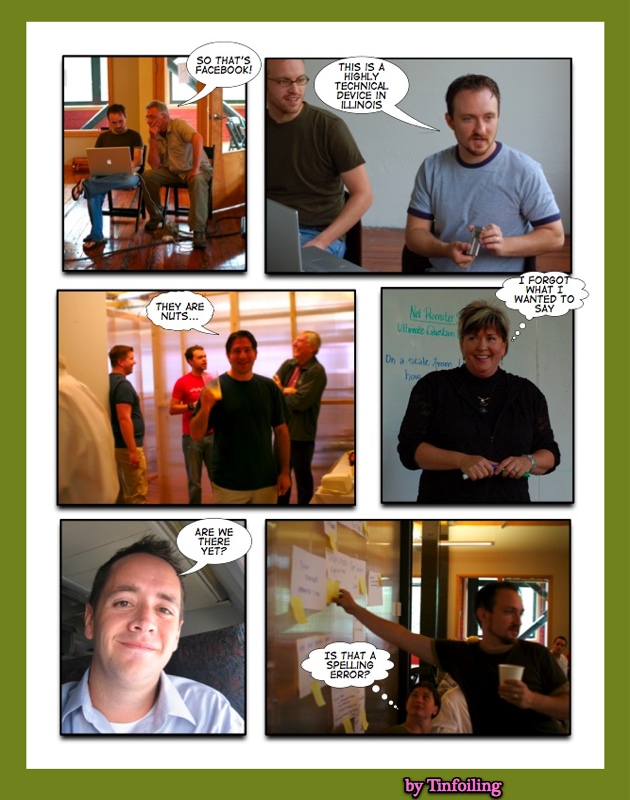
I love this picture of a group of employees at a high tech company. They look like a team. Maybe our next staff picture should be taken like this one.

caminoscreensnapz003.jpg

BC Lions Fanfest

Yesterday I was out at the BC Lions FanFest in Abbotsford. This year we decided to purchase season tickets for the Lions so this was a great place to start, seeing the players and fans. There was a lot of things for the kids and it was just too bad it was raining.
My days with the Lions go back to 1963 when my cousin and I went to just about every game as members of the BC Lions Quarterback club. For 50 cents you got into every game with seats in the end zone. The view wasn’t always great but what did you now you were a kid. I remember one game with Calgary and Willie Fleming running from our 15 yard line right up the middle for a touchdown. They went to the Grey Cup lost and went again in 1964 to win it. Then in 1977 had seasons tickets when Jerry Tagge was winning games that they shouldn’t have. That was an amazing year. So the question this year is will they be able to repeat last year? Who knows. Going to the FanFest made winning not as important as it sometimes seems. You know you are getting old though when some of the players refer to you as ‘sir’. liona.jpg